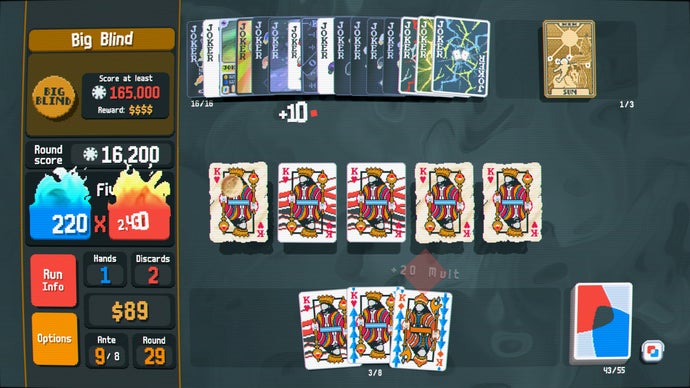
Krafton's European investment chief Victor Lee has grown weary of pitches for roguelike deck-builders that merely reskin Balatro's formula with different card art. Speaking at Digital Dragons, Lee expressed frustration with developers proposing incremental variations on the hit indie title without genuine innovation.
The complaint reflects a broader tension in game pitching. Balatro's 2024 success spawned a wave of similar projects, but most lack the design discipline and mechanical depth that made the original roguelike card game resonate with players. Publishers and investors now hear endless variations: "Balatro but with Pokemon cards," "Balatro but with horror themes," "Balatro but with crypto."
Lee's candor highlights a market saturation problem. When a breakout indie hit finds success, the industry's first instinct is often imitation rather than inspiration. Developers rush to capture lightning in a bottle by copying the surface mechanics while missing the underlying systems design that made the original work.
The roguelike genre itself remains open territory. Titles like Slay the Spire, Hades, and Dead Cells proved the category sustains multiple approaches. But there's a difference between iterating on genre conventions and simply swapping assets. Balatro succeeded through elegant ruleset design, perfect difficulty scaling, and satisfying loop progression. Copying the visual presentation without understanding these fundamentals produces shallow products that struggle to find audiences.
Krafton's position matters. The South Korean publisher backed successes like PUBG and Valorant and maintains significant investment capital. When a publisher executive this visible signals fatigue with a specific pitch type, developers listen. The message: bring genuine innovation or don't pitch at all.
The comment also reflects investor reality. Venture capital and publishing deals require differentiation. "Balatro with different art" offers minimal competitive advantage and poor market positioning. Smart publishers