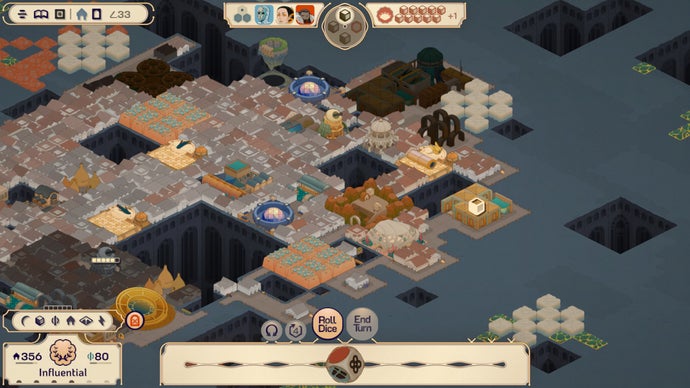
Amberspire ditches traditional city-building mechanics for something stranger. Lunar Division, the studio behind The Banished Vault, crafted a turn-based puzzle game where players manage competing urban forces rather than constructing infrastructure from scratch. The setting sprawls across a moon-sized necropolis, a Venetian graveworld whose isometric landscape reveals layers of archways and catacombs descending into darkness.
The game embraces what the developers call "ecopoetics of urban sprawl." Rather than giving players direct control, Amberspire presents a system of unpredictable agencies that demand careful management. Each turn introduces new complications. Players navigate systems that feel organic and chaotic, reflecting how real cities actually evolve beyond any single planner's vision.
This approach separates Amberspire from the SimCity template entirely. Those games let players zone districts and watch populations respond. Amberspire forces players to react to a city that develops with its own logic, shaped by competing interests and random complications. Strategy emerges from adaptation rather than pure construction.
The crypt permeates every decision. Resources hide in buried chambers. Growth spreads through broken structures. The aesthetic reinforces the design philosophy. A city emerging from a graveyard feels less like human achievement and more like nature reclaiming space. Building happens but it happens around you, through you, despite you.
Lunar Division demonstrates confidence in unconventional game design here. The studio proved it with The Banished Vault, a deck-building roguelike about managing a vault trapped in an infinite void. That game trusted players to embrace limitation and loss. Amberspire extends that philosophy into the city-building space, rejecting the power fantasy of total control.
The result positions Amberspire as a thinking person's strategy game. It appeals to players fatigued by conventional city-builders,